Monday, 7 July 2014

Big City (1937) - Film Locations

Luise Rainer and Spencer Tracy

When I really like an actor I feel the need to see all of their films. I know not all of them will be great. Some will probably be only so-so or simply bad, but I get some enjoyment from watching the smaller or maybe less appreciated films that my favorite stars appeared in. At times I'm even surprised and a movie that I go into not expecting much turns out to have some qualities I really like. That's what happened when I watched Big City (1937), starring Spencer Tracy and Luise Rainer.

Tracy plays a New York City cab driver married to an immigrant wife (Rainer). The two are madly in love but things are tough in the big city, especially for independent cab drivers trying to make a living like Tracy, who are constantly being harassed by the big unionized cab drivers. Things get out of control, escalating to an all out battle between the independents and the union cabbies. After one person dies in an explosion, Tracy's immigrant wife is threatened to be deported.

The trouble with Big City is the story is all over the place. What starts as a romantic drama evolves into a manic slapstick comedy by the end, when a brawl erupts between the independents, the union cabbies and some famous athletes. The feel of the movie is inconsistent. Nevertheless, Tracy and Rainer make this movie fun to watch. I really enjoyed seeing Tracy and Rainer on screen in the only film they made together. Some other gems include seeing cameo appearances by some famous athletes of the time and something I'm always interested in, real world film locations.

Click images to see larger.

Jack Dempsey's Restaurant as seen in Big City.

Former site of Jack Dempsey's Restaurant in New York.

Near the end of the film, Tracy barges into a dinner meeting taking place inside Jack Dempsey's Restaurant. Tracy's wife is about to be deported and he pleads with the mayor, who is speaking at the dinner to help him, that if anyone could save his wife, it would be the mayor. The restaurant was a real location,  located at 8th Avenue and West 50th Street in New York and owned by heavyweight boxing champion Jack Dempsey, who has a cameo appearance. The place opened in 1935, just a couple years before Big City was filmed.  Above is an image of Jack Dempsey's Restaurant as it appears in the film and below that is a vintage postcard image of how the restaurant looked.


The mayor decides to help Tracy. Escorted by some of the other dinner patrons (more famous athletes including Jim Thorpe, Jim Jeffries and Maxie Rosenbloom) the group races to the docks in a few cars to stop the ship that is about to deport Rainer. We see the cars race down two more real New York streets and then suddenly, for someone looking closely, one will notice the cars are racing down the streets of Hollywood! Below are two more views of New York and then the jump to Hollywood.

The first view is of Broadway, near the Jack Dempsey Restaurant location. In this view we see the Trans-Lux Theatre, located at 1619 Broadway. This theatre, which opened in 1931, was struggling by 1937 when this film was made. What's interesting is that in 1937, Jack Dempsey and his business partner Jack Amiel purchased the Trans-Lux property and converted the site into Jack Dempsey's Broadway Bar and Cocktail Lounge.

Trans-Lux Theatre, 1619 Broadway, New York

Contemporary view of the Trans-Lux Theatre site.

The next New York view seen in the film shows us the corner of West 47th Street and Broadway in Times Square. The most prominent building that can be seen in the screenshot is the Florsheim Shoe store. It's amazing how different Times Square looks today compared to 1937.

W. 47th Street and Broadway, New York

W. 47th Street and Broadway, New York

Now we jump to the Hollywood locations. As Tracy races down the New York City streets to reach his wife before she is deported we suddenly see the cars driving down Hollywood Boulevard and also down Ivar Avenue. Some of the buildings that can be seen are the Hollywood Citizen Stationary Store, a Schwab's store, Nancy's, Delphene's, a Thrifty Drug Store, a Colombia building, the Guaranty Building and the Broadway Hollywood Building.


Looking west down Hollywood Blvd from Cosmo St.

Above is the first shot of Hollywood. This view is looking west down Hollywood Boulevard from Cosmo Street. The building with the neon "Dentist" sign is part of the Julian Medical Building, a former drug store with medical offices on top.

Hollywood Blvd at Cosmo St.

Corner of Hollywood Blvd and Cosmo St.

Corner of Hollywood Blvd and Cosmo St.

Former site of Schwabs and Hollywood Citizen Stationary.

Tracy's car races past Schwabs.

Thrifty Drug Store, SW corner of Hollywood Blvd at Ivar Ave.


Former site of Thrifty Drug Store, Hollywood Blvd at Ivar Ave.

Guaranty Building 6331 Hollywood Boulevard.

Guaranty Building 6331 Hollywood Boulevard.

Looking east down Hollywood Blvd from Ivar Ave.

Looking east down Hollywood Blvd from Ivar Ave.

Above is a view looking east down Hollywood Boulevard. The "Columbia" building is now hidden behind some trees. Below you can see a closeup image of this building to see how this building looks now. In the background of the screenshot the signs from the Broadway Hollywood Building and the Taft building can be seen - both buildings are still standing at the corner of Hollywood and Vine.

The former Colombia Building 6324-32 Hollywood Blvd.

Big City (1937) is available for rent through ClassicFlix. The film was directed by Frank Borzage and also stars Charley Grapewin, Janet Beecher, Eddie Quillan, Victor Varconi, Oscar O'Shea, Helen Troy, William Demarest, John Arledge, Irving Bacon, Guinn 'Big Boy' Williams, Regis Toomey, Edgar Dearing, and Paul Harvey.

All screenshots (c) Warner Home Video. All contemporary images (c) 2013 Google, except Jack Dempsey Restaurant site courtesy of ScenePast.

Tuesday, 24 June 2014

Meet John Doe (1941) - Film Locations


Frank Capra is one of those directors where I can watch just about any one of his films and be entertained. Many of Capra's movies are heavily sentimental, wholesome message pictures which some critics have dismissively referred to as "Capra-corn." Although Capra's filmmaking style may seem a bit old-fashioned, for me personally it's one of the qualities I enjoy about Capra's films, and regardless of Capra's style, the subject matter in his films from the 1930s and 1940s, are just as relevant now as they were then. Whether it be a naive scout leader who thinks by becoming a senator and going to Washington he can help his country in Mr. Smith Goes to Washington (1939) or a presidential candidate who struggles to stick by his ideals and not sell out to special interest groups in State of the Union (1948), Capra's films touch on subjects that still strike a chord as a contemporary viewer watching the current political circus taking place.

The film Meet John Doe (1941), starring the always wonderful to watch Gary Cooper and Barbara Stanwyck, is another Capra classic portraying a "common man" fighting greed and corruption for the greater good of society. In this story, Stanwyck is a reporter who finds out that she is being laid off. For her last column she publishes a letter from a fictional "John Doe" who threatens to kill himself on Christmas Eve in response to society's inattention to people in need. When the letter is printed it causes a sensation and newspaper sales spike.  Stanwyck is kept on at the newspaper to continue her charade and to exploit the popularity of John Doe to sell more papers. After interviewing several hobos, Stanwyck discovers John Willoughby (Gary Cooper), a former baseball player in need of cash to repair an injured arm, to portray her John Doe.

With Cooper as the face of John Doe, Stanwyck continues to be John Doe's voice through her typewriter, publishing a series of letters from John Doe in the newspaper. With people all over the country stirred by John Doe's philosophy, the newspaper's publisher, D.B. Norton, decides to take things further and hires Cooper to give radio speeches which Stanwyck will write. A grassroots movement begins with John Doe supporters around the country creating John Doe clubs, with the simple philosphy of "Be a better neighbor."Intending to capitalize on John Doe's growing popularity, Norton plans to use John Doe to endorse him as a presidential candidate. Cooper himself begins to believe the John Doe philosophy, realizes he is being used and attempts to make things right with the public by exposing the entire scheme.

There is no real life city mentioned in the film, only a fictional town called "Millville" but the exterior scenes were all filmed in the Los Angeles area, including the Warner Bros. Studio backlot in Burbank. Here are a few of the Meet John Doe filming locations as they appear today.

Looking south down Vine Street just above Yucca Street.

Looking down Vine St. above Yucca St. as it appears today.

When John Doe is going to make his premier on radio, the scene opens with a shot of a guy hammering an advertisment to a pole that is on Vine Street in Hollywood. The camera gives us a view looking south down Vine Street from just above Yucca Street. We get a glimpse of the Broadway Hollywood building on the right. Just behind the bill advertising "Hear John Doe TONIGHT 9 P.M. W.B.N." is where today stands the Capital Records building, which wasn't finished until 1956, fifteen years after Meet John Doe was made.

NBC Studios, corner of Sunset Blvd. and Vine St.

Former site of NBC Studios at Sunset and Vine.

The location where Cooper gives the radio speech as John Doe is NBC Studios in Hollywood, located at the northeast corner of Sunset Boulevard and Vine Street. The art deco NBC building opened in 1938 and was the West Coast headquarters for NBC Radio Networks. In 1962 NBC moved to a new building in Burbank and in 1964 the Hollywood location was demolished. Today the site is the home to a Chase bank.

The "Millville" town square is Midwest Street at Warner Bros.

Midwest Street at Warner Bros. Studio, Burbank, Ca.

Later in the film, after Cooper realizes he is being used and decides to go back to obscurity, he is recognized in a diner in the small town of "Millville." Millville is really part of the Warner Bros. Studio backlot area known as Midwest Street. In the screenshot above the people of Millville frantically run across the town square to get a glimpse of John Doe. Midwest Street has appeared in numerous films including The Hard Way (1943), East of Eden (1955), The Music Man (1962), Suppose They Gave a War and Nobody Came? (1970) and The Monster Squad (1987) to name a few.

Millville City Hall

The city hall building on Midwest Street.

Looking across the Millville town square.

Looking across Midwest Street.

Near the end of the film, Cooper is supposed to give a big speech as John Doe endorsing Norton for president. Instead, Cooper plans to expose the whole deceptive scheme. The big speech takes place in a stadium and the stadium that was used for filming was Wrigley Field in Los Angeles. The stadium was located on 10 acres between San Pedro Street to the west, Avalon Blvd to the east, E. 41st Place to the north, and E. 42 Place to the south. The stadium opened on September 29, 1925 and for 33 seasons was the home to the Angels and for 11 seasons it was also the home to the rival Hollywood Stars. The stadium was eventually demolished in 1969.


Wrigley Field Los Angeles as seen in Meet John Doe.

Aerial view of Wrigley Field's opening in 1925.
Image from Los Angeles Public Library.

Aerial of the site of Wrigley Field as it looks today.

In the two images above, the first yellow rectangle shows the portion of the stadium that appears in the film and in the second image the yellow rectangle shows where that portion of the stadium would be if the stadium were still standing.

In the two images just below, the first is a screenshot showing the inside of Wrigley Field as seen in the film and the second is a clearer vintage photo from 1937, during a game of Hollywood comedians against Hollywood leading men.

Inside view of Wrigley Field as seen in Meet John Doe.

1937 Comedians vs. Leading Men game.
Image from Los Angeles Public Library.

The end of the film involves Cooper contemplating jumping from City Hall on Christmas Eve. Although Los Angeles is not mentioned as the location of the story, the city hall that is used for the story is the Los Angeles City Hall as seen in the screenshot below. However, it looks like the LA City Hall was recreated in one of the Warner Bros. Studio sound stages. For one, the skyline is different and second, although possible, its not likely to be snowing in downtown Los Angeles.

City Hall as seen in Meet John Doe.

The Los Angeles City Hall.

I highly recommend this film. If you haven't yet seen this classic, ClassicFlix currently has Meet John Doe available on DVD to buy or to rent.

Images (c) Warner Bros. Entertainment, (c) 2013 Google, (c) 2013 Microsoft Corporation Pictometry Bird's Eye (c) 2012 Pictometry International Corp.

Monday, 9 June 2014

Welcome, Foolish Mortals: The Life and Voices of Paul Frees


First up as part of my participation in the classic film book summer reading challenge is Welcome, Foolish Mortals: The Life and Voices of Paul Frees by Ben Ohmart. The name Paul Frees may not be immediately recognizable but, as the title suggests, you're more than likely familiar with one of his many voices. Some of my favorites include his voices as the Ghost Host in Disneyland's Haunted Mansion attraction, as John Lennon and George Harrison for The Beatles TV series (1965-1969), the Pillsbury Doughboy, as various characters in those Rankin/Bass stop-motion Christmas specials, as well as various voices on Rocky and Bullwinkle. Prior to reading this book I knew of many of Frees' voice credits but I knew little about the man himself.

Born in Chicago, Frees got his start in entertainment in the 1930s doing impressions. He then got established in radio and developed the reputation as a talent you could count on. He appeared on popular radio programs such as Suspense and Crime Classics. Many times Frees was called in to fill in as the voices of popular celebrities such as Peter Lorre and Humphrey Bogart. According to Frees, Bogart once told him that "you sound more like me than I do." Later in his career, once while seeing Sammy Davis Jr. perform in Vegas, Davis admitted to the audience that he was embarrassed to do impressions for them because there was someone who was sitting in the audience they probably didn't know that was considered the best at doing impressions - referring to Frees.

Frees was known to antagonize his coworkers on occasion and one of my favorite stories involves a time he worked at NBC in Hollywood with Lionel Barrymore on the Dr. Kildare radio program. Frees explained, "Oh, the terrible things I used to do to Lionel Barrymore. He was in a wheelchair and outside of NBC at the corner of Sunset and Vine across the way there was a place called The Key Club we used to go to. I would wheel the old man behind there, and I would start running and I would wheel his wheelchair so fast down the ramp. I'd be wheeling him at 30, 40, 50 miles an hour and he'd be shouting, 'You sonofabitch, if you don't stop this chair...!" I can just picture a perturbed Barrymore yelling at Frees.

Paul Frees with Fred MacMurray in the Shaggy Dog (1959).

Frees did appear in some films, but mostly in minor roles. Some of his film credits include Reverend Morrison in A Place in the Sun (1951),  Corley in His Kind of Woman (1951), and as one of Sinatra's thugs, Benny in the film Suddenly (1954). However, Frees never got beyond minor roles and was more likely to be hired to do voice-over work and provide dubbing for films. For example, in Patton (1970) he provided the voices for a war correspondent, one of Patton's staff members, and the voice of a sheik. He also dubbed for Humphrey Bogart in Bogart's last film role, The Harder They Fall (1956).

Paul Frees in one of his three-piece suits.

I was most interested in learning some of the quirky things about Frees. Like how Frees grew a big, Edwardian looking mustache and how he was always impeccably dressed. Frees often wore three piece suits and had a large collection of pocket watches, along with a large collection of different watch fobs. Frees was short but would talk like he was the biggest person in the room. Because he was short and he dressed flashy, Frees always carried a gun for protection. During the 1960s, he had a side gig working as an undercover narcotics agent for the DEA in Marin County. In addition to voice talents, Frees was also a gifted painter, writer and singer. He got around in a Rolls Royce and frequently had someone else drive him. Frees purchased one of the first VCRs and recorded thousands of tapes worth of TV and movies. He was a homebody who loved watching TV.

After establishing himself in Hollywood Frees moved to Tiburon, California near San Francisco. Frees built his dream house, a multi-story home on the side of a cliff. Frees no longer needed to be in Hollywood to find work. The work came to him. At his peak Frees would make the claim that he earned more per hour than any other star in Hollywood. He could go into his home studio or fly down to a studio in LA, and in less than an hour be finished, earning sometimes as much money in that time as some actors would for working through a whole film. Meanwhile Frees was ready already on to the next gig.


The highlight of Frees career was the work he did for Rankin/Bass such as the animated version of The Hobbit or the stop-motion Christmas classics Frosty the Snowman (1969), Santa Claus is Comin' to Town (1970), or Rudolph's Shiny New Year (1976) and the work he did for Jay Ward Productions including The Rocky and Bullwinkle Show and Dudley Do-Right.

One of the many advertisement characters Frees voiced - the Pillsbury Doughboy.

Providing his voice to advertisements was another lucrative gig. In addition to the Pillsbury Doughboy, Frees voiced Toucan Sam, the 7-Up bird Fresh Up Freddie, the Little Green Sprout from the Jolly the Giant commercials, and as the announcer for the Mr. Goodwrench advertising campaign just to name a few.

For me, I'm reminded of Paul Frees every time I go to Disneyland. His voice can be heard on the Haunted Mansion ride and the Pirates of the Caribbean attraction and he also lent his voice to numerous other Disney projects.

I really enjoyed reading about the interesting life of Paul Frees. The book was filled with plenty of fun facts, and the author, Ben Ohmart, has also released an updated edition with additional information and photos.

Friday, 30 May 2014

My Summer Classic Film Book Reading List For 2014


Raquel of Out of the Past - A Classic Film Blog is once again hosting a classic film book summer reading challenge. I missed out last year, but I thought if I participated in the challenge this year, it would be the kick in the pants I need to get caught up on some books that I've been putting off reading. The goal is to read six classic film related books by the end of summer. If you participate in the challenge you are also eligible to win a prize. Full details can be found at her blog here.

Here is my summer reading list:


First up is Welcome Foolish Mortals...The Life and Voices of Paul Frees by Ben Ohmart. I've always been fascinated by the many voices of actor, artist and foremost voice talent, Paul Frees. I know his voice well from Disney's Ludwig Von Drake or the Haunted Mansion ride's "Ghost Host," the Pillsbury Doughboy, and from impersonating everyone from Orson Welles to Peter Lorre; but I never knew much about his personal story. There has since been a revised edition of this book but a friend had already given me a copy of the first edition.


Next is Life at the Marmont: The Inside Story of Hollywood's Legendary Hotel of the Stars--Chateau Marmont by Raymond Sarlot and Fred E. Basten. I had the opportunity to attend a private party and crash in one of the hotel's suites a few years ago. It's an amazing hotel that just feels old Hollywood. I've been waiting to dig into this book to find out more of the hotel's storied past.

What would Hollywood be without a few wild guys around? Hollywood Hellraisers: The Wild Lives and Fast Times of Marlon Brando, Dennis Hopper, Warren Beatty, and Jack Nicholson by Robert Sellers is next on my list.


Carole Landis is one of Hollywood's tragic characters so I'm curious about this book, Carole Landis: A Most Beautiful Girl by Eric Gans.


Next is Humphrey Bogart from TV Guide's American Icons series. This isn't really a book but it's more than just a magazine. Flipping through the pages I'm already attracted to the many stunning images of Bogart and intrigued by the different articles on his life.


One of my favorite actors from early Hollywood is Glenn Ford. The guy just seemed so cool, especially in all those film noirs. Last on my list is Glenn Ford: A Life by Peter Ford.

If you would like to participate in the summer reading challenge head on over to Out of the Past to fill out a form and get the full scoop. I'll be publishing my reviews of the above books throughout the summer.

Happy Summer Reading!

Tuesday, 20 May 2014

Cass Timberlane (1947) - Film Locations


In the film version of Sinclair Lewis's story, Cass Timberlane (1947), Spencer Tracy plays the title character, a judge who falls for a younger woman (Lana Turner) from the "wrong side of the tracks." Although the story for Cass Timberlane is set in a small Minnesotan town, filming actually took place in California, around Los Angeles and the MGM Studios backlot in Culver City. Early in the film, when Tracy first meets Turner, he literally crosses the railroad tracks but they are a long way off from Minnesota. 

In the scene below Tracy sees a baseball roll from underneath a railroad car. Tracy is standing near Myers Street, just north of the 1st Street bridge in downtown Los Angeles. 

Click images to enlarge.


Tracy stands on N. Myers St near the 1st Street bridge.

Looking toward the 1st Street bridge from N. Myers St.

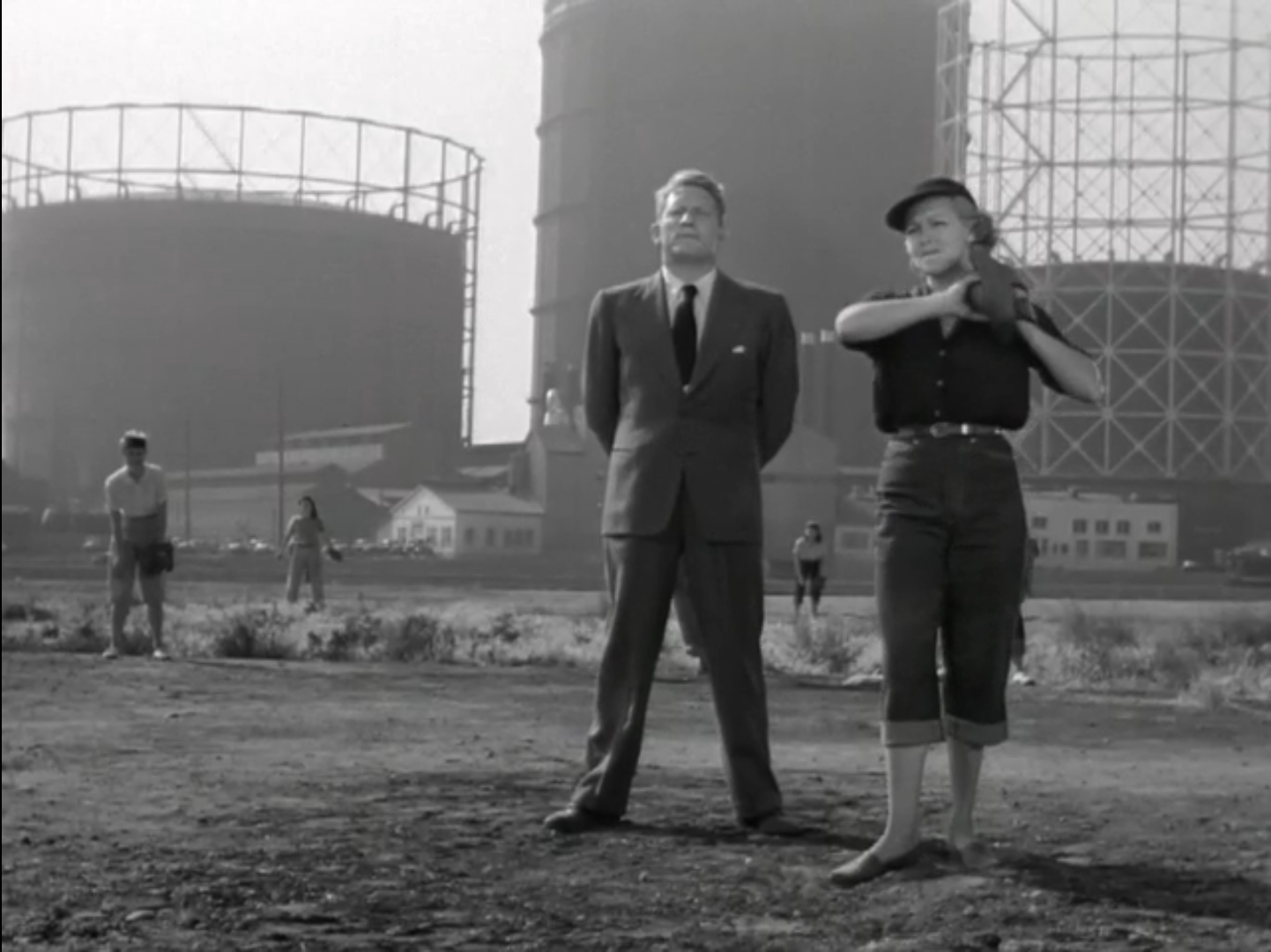
Tracy joins the action of a baseball game taking place in a parcel of land north of the 1st Street Bridge and east of the Los Angeles River. Naturally, being a judge, Tracy acts as the umpire. While Tracy stands next to Turner near the pitching mound, we get a view of the Southern California Gas Company tanks that once stood near Jackson Street and Center Street, just across the LA River. These recognizable structures appeared in quite a few early films before they were razed, and were particularly popular in film noirs.

Tracy and Turner with the The Southern California Gas Company tanks in the background.

Looking across L.A. River towards Jackson Street. The gas tanks have since been razed.

A closer view of the tanks that stood near Jackson St. and Center St.

Spencer Tracy's home in Cass Timberlane was one of the homes originally built for the popular Vincente Minnelli film Meet Me in St. Louis (1945) starring Judy Garland. For Meet Me In St. Louis, Minnelli insisted that MGM construct an entire street of Victorian homes rather than dress an existing set, which would have been much cheaper. The sets remained well after Minnelli's film, getting their fair share of screen time. Tracy would not only work on this St. Louis Street backlot for Cass Timberlane, but also in the film  The Sea of Grass which came out the same year.

Tracy walks home, one of homes on MGM's St. Louis Street backlot.

Cass Timberlane is available on DVD through the Warner Archive Collection, it can be rented through ClassicFlix, and is currently available for streaming on the Warner Archive Instant service.

Monday, 12 May 2014

Katharine Hepburn's Hiking Spot

 Hepburn hiking country road during break from filming in London.

Katharine Hepburn was always athletic. At an early age, while growing up in Hartford, Connecticut, Hepburn's father, a doctor, encouraged his kids to swim, play tennis, ride horses and golf. Swimming was an activity that Hepburn was particularly fond of and she would continue to swim regularly even into her 80s. Another activity that Hepburn enjoyed doing for exercise was hiking and during her time living in Los Angeles, one of her favorite hiking spots was by the Franklin Canyon Reservoir.

 Franklin Canyon Lake at Franklin Canyon Reservoir. Source.

Located just below Mulholland Drive, west of Coldwater Canyon and near Beverly Hills and Studio City, Franklin Canyon Reservoir feels like an escape from the city. No wonder why Hepburn, someone who enjoyed her privacy, liked hiking this spot. Without ever having visited the canyon, you may recognize the location from numerous appearances on film and television. Shows like Bonanza, The Waltons, Lassie, Murder She Wrote and Combat have filmed scenes here. During the opening credits of each episode of The Andy Griffith Show one can see Griffith and little Ron Howard walking around the 3-acre lake. The films It Happened One Night (1934), The Lady Escapes (1937), I Met My Love Again (1938) and even the Hepburn film On Golden Pond (1981) have filmed scenes at Franklin Canyon Reservoir.

The Andy Griffith Show filmed at Franklin Canyon Reservoir. Source.

During Hepburn's years with Spencer Tracy, she would urge him to join her for walks around Franklin Canyon Reservoir. In early 1964, a few months after Tracy had started to recover from a major health scare, Hepburn purchased a police dog named Lobo to encourage Tracy to go on walks at the reservoir.

 Spencer Tracy, Ruth Gordon, Garson Kanin, Katharine Hepburn

Hepburn's friend, the writer Garson Kanin, in his memoir on Hepburn and Tracy recounts a story in which Hepburn played hero in the rescue of a kidnapped boy during one of her hikes at the reservoir. In 1969, the teenage son of Dr. Simon Ramo, a wealthy aerospace executive living in Beverly Hills, was kidnapped. During Hepburn's hike she heard some yelling. She was then approached by a police officer who had been called out by the reservoir keeper. Kate pointed the officer in the direction of the keeper's house and later the boy was recovered unharmed. One can imagine that Hepburn's involvement was probably played up for dramatic effect.

On a side note, during the early 1960s Hepburn's frequent co-star, Cary Grant, participated in supervised medical LSD experiments. Grant was a proponent of LSD "therapy" and claimed that it helped to control his drinking and to come to terms with unresolved conflicts he had about his parents. While praising the benefits of LSD Grant mentioned, "Just a few healthy magnums of LSD in the Beverly Hills reservoir..." So while Hepburn hiked the reservoir Grant found relaxation in the reservoir in his own way.

Address for the trailhead: Lake Drive & Franklin Canyon Drive, Franklin Canyon Park, CA 90210

This post is part of The Great Katharine Hepburn Blogathon hosted by blogger Margaret Perry.